
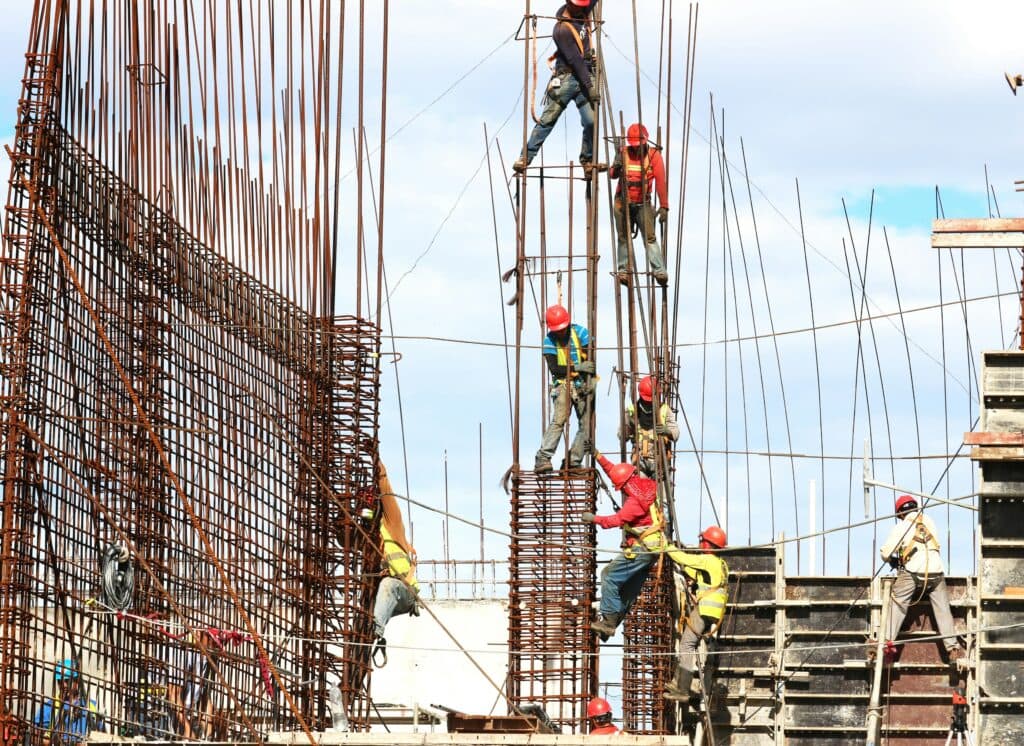
When is a SiGeKo required?
There is no direct rule that prescribes a specific number of workers or a specific number of hours. Nevertheless, the following rules of thumb apply:
- With at least 20 workers on site at the same time, the need for detailed safety coordination increases.
- If the construction period is expected to exceed 30 working days and more than 20 workers are on site at the same time, prior notice must be given to the competent authority (§ 2 BaustellV). This often also indicates the need for a SiGeKo.
According to RAB 30, the qualification requirements for the coordinator depend on the type and scope of the construction project.
Plan your project with us in advance.
Practical examples of SiGeKo coordination under BaustellV and RAB 30
A SiGeKo (health and safety coordinator) is used in particular on construction projects where several employers or trades work at the same time or one after the other. The German Construction Site Ordinance (BaustellV) sets out the requirements for coordinating health and safety on construction sites. RAB 30 specifies, among other things, the qualification requirements for the SiGeKo.
Example 1: SiGeKo for an industrial and plant construction project
When a production plant, tank farm or similar industrial facility is built or extended, several companies and trades often work together on one site. These include civil engineering, steel construction, pipeline construction, plant assembly, electrical engineering, scaffolding and insulation.
The different activities create numerous interfaces and mutual hazards. Crane and lifting work may take place in parallel with assembly work, for example, while work at height, site traffic or welding is carried out at the same time.
The SiGeKo coordinates the safety-relevant interfaces between the employers and trades involved and supports the client in implementing the requirements of the BaustellV. This includes coordinating protective measures, taking into account hazards from work carried out simultaneously or consecutively, and updating the SiGe plan where required.
Example 2: SiGeKo for solar and photovoltaic systems
Health and safety coordination may also be required for larger solar and photovoltaic projects. Here, different companies and trades often work together – for example civil engineering, installation companies, electrical contractors, scaffolders and other subcontractors.
For Enteria Energietechnik GmbH, for example, we coordinated the safety aspects of installing solar fields in cooperation with WSW. The various workflows, companies involved and site areas, as well as the interfaces between the individual activities, were taken into account and coordinated.
Especially on larger construction projects with several employers, structured SiGeKo coordination under the BaustellV is important in order to identify mutual hazards early and define suitable protective measures.
SiGeKo for construction and industry
Whether for industrial plants, production facilities, photovoltaic systems, commercial buildings or other construction projects: whether a SiGeKo is required, and what scope of health and safety coordination is necessary, always depends on the specific circumstances of the project.
We support clients, companies and project managers with SiGeKo coordination under BaustellV and RAB 30 – from assessing the coordination required to carrying out the coordination tasks on site.
Are you planning a construction or industrial project and are unsure whether a SiGeKo is required? Get in touch. We will review your project and advise you on the required scope of health and safety coordination.